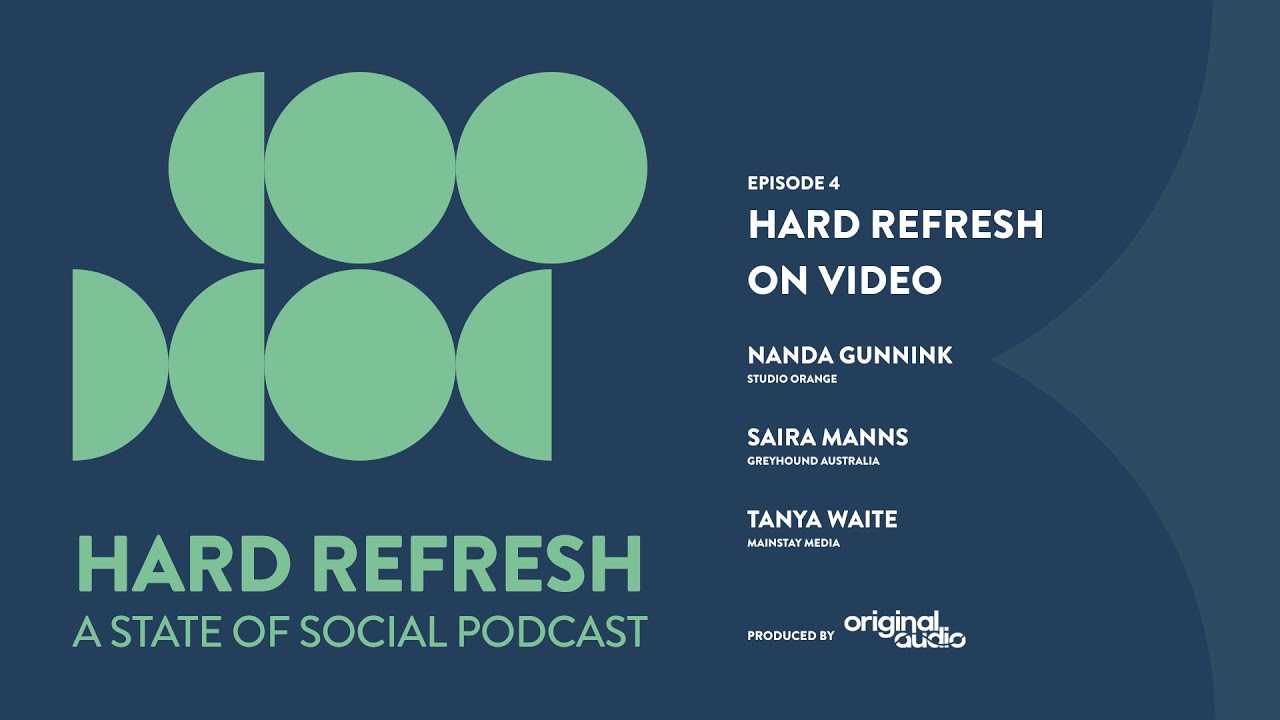
Hard Refresh on video
Listen on
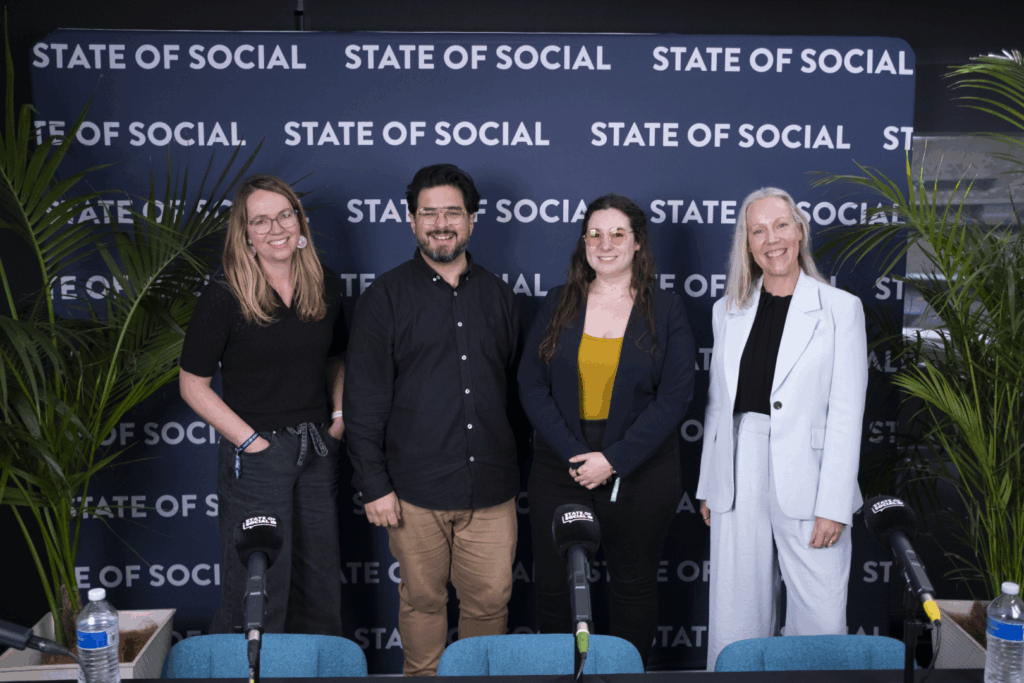
Around the table
- Nanda GunninkStudio Orange
 Saira MannsGreyhound Australia
 Tanya WaiteMainstay Media
Coming to SOS27?
| Dates | 24 & 25 August 2027 |
| Venue | Optus Stadium, Perth |
| Tickets | On sale 11 January |
Listen on
Hard Refresh · episode 04
Watch 40 min
Transcript
Automatic captions, names checked:
[0:05] Hello and welcome to Hard Refresh, the official podcast from State of Social 2025. And what are we doing here, you might ask? Well, we’re polishing off the standard issue State of Social Crystal Ball to discover what’s in store for the next 25 years in digital marketing. We’re diving deep on the trends, technologies, the cultural shifts, and maybe even the controversies that are likely to shape this industry for many years to come and society at large. My name is Andrés López-Varela. You can call me ALV. All my mates do. And today we are recording on the traditional lands of the Whadjuk Noongar people live at State of Social 2025. And in this episode, we’re doing a hard refresh on video. Video has dominated the past decade and become the preeminent format for marketing content. But the ground keeps shifting. Short form scroll culture,
[0:57] creator aesthetics invading brand work, and streaming that blurs the lines between TV and digital and every other form of video. Over the next 5 years, we’ll likely split the craft into two. lowfi for discovery and premium for deep storytelling while teams adopt more of a newsroom speed workflow with platform sensibilities to make sure their storytelling lands. But what’s beyond that? What does AI assisted production, synthetic talent, and even video that’s aware of its own context mean for us marketers? More than ever, the questions about what to make, where it should live, and how to prove it delivered more than just views are going to be more and more difficult to answer. And here to help me hit refresher on everything we think we know about video is Nanda Gunnink, the managing director of Studio Orange, an animation and video studio here in Perth. Nanda, welcome to the show.
[1:48] Thanks for having me. Saira Manns, the PR and social media manager at Greyhound Australia. So happy to have you with us, Sarah. Hi, good to be here. Thank you. And Tanya Waite, director of PR at Mainstay Media and former journalist as well. Tanya, thanks for joining us. Thanks. Thank you so much. Thank you so much. And uh yeah, very happy. Great, great diverse group. Is everyone enjoying State of Social so far? Yes. Yes. Yes. Is it everyone’s everyone’s been before or first time? I’m a first- timer. Oh, yeah. Yeah. How’s it turning out?
[2:16] It’s been great so far. Yeah. Learned a lot already. Great. Excellent. Enjoyed the session from this lovely lady next to me. Thank you. Excellent. This is this is my fourth year. So, um I guess I’ve had a bit of um first year presenting, but the three years previously, lots of great speakers up there. So, lots of cool people to learn from and Great. Yeah. Excellent. Well, thank you so much for joining us today. Are you ready? Yes. Yeah. Time to do a hard refresh. All right. Everywhere we look these days, it feels like another channel has become all about or mostly about video, right? It feels like, you know, everything from
[2:53] like six-second swipes to like 60-minute like sitdowns and lean lean backs. If we zoom in though on the last two years, Nanda, what feels to you like the most important like shift in video that you think is going to become structural for the next sort of, you know, 5 to 10 years? Not something that’s like a fad, but something that you go, “Oh, I think that’s really going to shape things for a while to come.” Yeah, that’s a really really great question to start us off with. Um, I think what I’ve what I’ve seen in um content production and in in video over the last two years, and I think this has been a bit of a shift in our production team as well, is how can we produce content that’s um entertaining? And when I say entertaining, I don’t even mean like funny. It’s not about being funny. It’s just about how can we create content
[3:42] that actually just has some kind of entertainment value that keeps our audience engaged and keeps our audience hooked in. Um, and I think that especially in the corporate brand brands that we work with, um, we’re starting to see a slow shift of customers accepting that sort of entertaining angle. So, how can we make something that’s a bit different? How can we push um you know we might have a small budget but how can we get the most out of that specific budget to to reach our um our target and our purpose and um to create something that’s entertaining and interesting to watch and I think that’s a big shift that has sort of started um uh arising but I think that there is there’s so much more that we can do and we all I think especially with AI will see this sort of divide of like human created
[4:33] content versus AI created content. Um, but yeah, I mean the landscape’s always changing. So, you know, it’s just a matter of keeping on top of it. Yes. Yeah. Well, that’s a good one. I think the entertainment thing and sort of an acceptance maybe from brands that entertainment is not just humor. I guess that’s sort of a larger a larger sensibility around that as well. What do you think, Tanya? Do you think that’s something structural? Do you think it’s something else? Well, look, entertainment, I guess, is always going to be the fact that there’s so many different videos now that people can look at. So, if you’re not capturing their attention right at the start, they’re just going to move on to the next thing. So, no, I agree. I think the other thing um that’s been touched on as well, I guess, over the sessions today, is just that community and connection as well. Um, and I think that human storytelling is always going to remain really important.
[5:22] Yeah. Excellent. Sarah, what do you think? Entertainment. I mean, entertainment for sure, but one of the um sessions I saw earlier today from Sharon um had entertainment and humor down the bottom of the list or towards the bottom of the list for statistics of what types of content that actually inspire people to take action. And number one and number two were informative and relatable. So, of course, there’s there’s a place for humor and entertainment, but if people are actually learning something or they are they can see themselves in the video and they can relate to it, that’s what’s going to encourage them to save it for future reference. Um, or to share it with their friends or to share it with somebody. My friends and I, we just send
[6:05] each other videos all the time with just it you it. Yeah. you and that’s what is entertaining about it is that you can relate to it and that you’re getting information from it. I think the the lines are blurring very sharp sharply the lines are blurring very strongly between entertainment and education a lot of the time you know probably with brands like that’s kind of the safest way into that I think yeah it’s yeah it’s interesting to hear you say that because actually when I speak about entertainment I speak about it from sort of my lens and angle and a lot of the content we make is informative educational um I mean it’s you know it’s all sorts of wild and wonderful and random things that we actually create content about but um just saying here’s a here’s a couple of statistics and a couple of numbers in a piece of you know content is going to be quite boring. So finding a way to tell a
[6:55] narrative and to include a story and then entertain then entertain and inform your audience. Absolutely. It’s that enterainment and infotainment side of things like it’s the second time I’ll refer to it today but my favorite podcast apart from this one of courseies with Ali Ward um I learn something different every single time. It’s about a different study of something in in the world, I guess. And so my entertainment comes from being informed about various topics that I might not have never even thought of, but there’s always something in there that I find relatable or funny or engaging, and that’s what keeps me coming back for more. And that’s interesting because I think that the like it’s it’s indisputable online audiences reward
[7:40] that real rough around the edges sort of like content. Um and I mean tell me Sarah from a brand point of view. Do you think that you can codify or formula or kind of you know formularize that sort of UGC style production? I mean that’s a that’s an aesthetic which has slowly grown to kind of encompass all manner of video. How do you do that as a brand without draining the kind of the spontaneity or the spark that gives that video its impact? Yeah, sure. I mean, for me with my content that I’ve produced for Greyhound Australia, I kind of took on the element of imagining myself as not an influencer per se, but just leaning into that lowfi
[8:24] UGC style of content. when it came to a time of having to put out information um that was really critical and timely. Yeah. I was literally I was working from home because there was a cyclone coming to hit Brisbane. Um but I was literally just at home on my couch or at the front of my house filming directly to camera editing very minimally natively within Tik Tok. um to the point that there were a few comments on the videos, you know, a few into the series of people saying, “I hope this is the official account of Greyhound.” Or people saying, “Oh my god, I’ve only just realized that this is the actual Greyhound account.” And to me, that’s such a win because the content was organic. Um and I know, I
[9:08] speak for myself, when I’m scrolling, I can immediately tell if something is branded or sponsored or comes from a brand, and I will just scroll on by. It used to be the norm, but now it’s exception, isn’t it? Absolutely. So, I think the more you can speak to your audience as a person and keeping in mind the key messages of your brand and your brand tone and personality and ultimately what your call to action is or with that in mind, the more you can relate to somebody one-on-one, the more likely they are to actually engage with your content and then follow you and come back for more and then maybe one day buy a bust. I don’t know. And do you think that’s because if it looks too branded, they just immediately think it’s advertising and just flick on by?
[9:51] I mean, that’s what I do. Um, and I, you know, been on social media for the majority of my life, which is scary to think about, but um, we’re we’re I know, right? We’re so we’re just so attuned to it now, and it’s like I don’t I don’t want to be seeing ads. That’s not why I’m here. I will immediately scroll past. I’m not here to be interrupted. Yeah. Right. It it’s like watching um commercial TV um filled with product placement. I’m like I’m not I’m not here to watch ads because you’re going to show me ads in the ad break.
[10:22] Like just show me and I want to mute those, you know. Yeah, exactly. Just show me the content that I’ve tuned in for. Yeah. None. What do you think? because I think the kind of video that that uh that you create at Studio Orange is maybe less of that sort of lowfi kind of, you know, rough and tumble style, but do you see in the future that aesthetic kind of bleeding into more of that style of video that that um is, you know, perhaps more structured, more pre-produced, you know, has a different objective in mind? So So in what case do you mean? Do you mean in like um the style that Sarah’s talking about where the videos are
[10:59] sort of, you know, low production value, low effort for like a quick turnaround that is, as Sarah pointed out, probably the mainstream aesthetic online now. Do you see that bleeding into, you know, the more sort of scripted, structured, pre-produced video? I think it I think for anything, it really goes back to purpose. I think it goes back to what’s the reason that we’re communicating a certain message and then how do we go about that. Um, and I think for brands like there’s no like you can’t be doing lowfi or you can’t you can only be doing like high quality high value production. like there’s no hard and fast rule for that because you know if you’re in the moment and you want to quickly record a behindthe-scenes kind of lowfi um user generated sort of look then great because that’s what’s going to work for your brand there and then.
[11:50] Whereas if you have a very complex message that needs to be approved by a whole range of stakeholders and there’s a lot of people involved in that message um and it needs to be pre-approved then you’re probably not going to do a lowfi piece of content. So, I think it goes back to that sort of, you know, what what purpose do we have? And in your case, like what you’re doing for Greyhound, that’s brilliant because you’ve got consumers at the on the other end that are, you know, waiting for that kind of content. I don’t have time to film and then upload to my desktop and then sit there and open up a a proper editing app and or program and and do all of that. I literally need to film quickly, edit, throw some captions on there, post it. Whereas when you might be working on like a a B2B campaign, then you might go actually we probably need to do something a little bit more high-end because then if we’re going to be serving up a lowfi piece of content, then that’s going to come across as a lowfi piece of content.
[12:40] Absolutely. There’s always going to be a place for both lowfi and high quality. Um I think where it gets interesting is as you said ALV before like where they start to bleed into one another. So, some really cool campaigns that I’ve seen recently have made use of UGC and have just featured actual Tik Tok videos. And it’s so refreshing, shall we say, to be watching commercial television and then an ad comes on and it’s just a collage of real people’s Tik Tok videos. Yes, someone actually gets it because that to me sells. I mean, this is probably a bad example because I can’t remember who the ad was for, but at that point in time, I’m like, this is this is capturing my attention. I actually want to unmute and watch this ad because
[13:26] they’re real people and they’re tapping into the online conversation. Yeah. I I want to talk a little bit more about about TV because you know one channel that’s in particular becoming uh too big to ignore is connected TV and you know um catchup TV where the media budgets are clearly rising but the craft still feels like it’s trapped in the 30-cond TVC and um it seems like a shame I guess n because like uh is do you see an opportunity there for a new style of video that can sort of emerge in that in that channel which is you know obviously it’s a piece of you know advertising brand advertising but you know with a little bit more personalization or some element of you know um
[14:12] internet sensibility if you like yeah and I yeah I do feel like there I feel like advertising has always had its own sort of island that they’ve lived on and you know I don’t think that that’s right and I for 80 years and I I think it’s probably about time that you know we sort of don’t we sort of acknowledge that the island needs to be part of the rest of of the the city and that we all just work on messaging and campaigns together. Um and I don’t know what that looks like, you know, for that to change. But um I do know that we’re not going to be well, I mean, some some brands will have budgets that are however many million dollar um campaigns, but there’s also going to be brands that won’t have that anymore. Yes.
[14:54] Um and I think that even for those kind of brands, there’s going to be more opportunity. um you know skills like technical technical skills capability is um is sort of coming up because we all live with media these days. So we’re all experts. Exactly. We don’t need a Yeah. We don’t need a a million-dollar campaign that targets a specific demographic. I think we um we can do very well with the skills that we have and that we can tap into um and the creativity that you know everyone brings to the table these days. We’re not Yeah. We’re not in the what’s the series Mad Man anymore anymore. Yeah. Um and I think obviously
[15:33] you know TV is interesting in uh you know looking projecting forward into the future as a as a medium itself you know like perhaps it won’t even be anything like you know broadcast television won’t be anything like what it is now if it’s there at all in like you know 15 20 years or something like that. And so it really changes the the dynamic between what lead what vid what type of video leads a campaign or leads you know a brand’s you know marketing if you like before it could have been the 60cond ad that premiered on a Sunday night you know in in the in the movie or whatever and now it’s the stuff on social media or it’s a YouTube pre-roll or something like that. So even the definition of TV seems to be shifting away from what we maybe are comfortable with, I guess.
[16:24] Absolutely. I mean, you just need to look at the rise in streaming services and um YouTube as a main long- form content channel. Yeah. And YouTube on the TV. Absolutely. YouTube on the TV. What a world. Um or Tik Tok on the TV. I learned that the other day and this is dangerous. But um you know it’s it’s just it’s completely different to what we were used to growing up with. And I sometimes feel that there is a lot of potential that maybe some of the traditional TV networks are missing out on in terms of really tapping into the social media landscape and repurposing their content in in vertical format and
[17:07] capitalizing on that and continuing that conversation online. And it astounds me how often I’m watching a show on TV, ad break comes on, mute the ads, open up Tik Tok or threads or whatever it might be and search for the show and I and I see and I see the content that has been posted by their official channels and I’m like this feels boring. Like this just feels very stagnant and scheduled and like something I would have expected. Like literally scheduled. I’m like, it probably is like the biggest burn you could give them. Why is their social manager not kicking back and like engaging? That’s what I would be doing.
[17:50] Um, and you know, repurposing that content and getting those short snippets and then you’re f you’re potentially finding an audience even on the other side of the world who sees a viral piece of video and then is like, “What’s that show?” And then all of a sudden you’ve got a lot of people watching something that they wouldn’t have known existed beforehand. Yeah. Yeah. I want to talk about AI. Mhm. It’s all over this podcast. It’s all over this conference. It’s all over everything. Everything, right? You can’t you can’t spell Sarah without AI. That’s true. Yeah. Yeah. Yeah. S. And for those of you watching at home, it’s S A I R A. Yeah. Good way to remember it.
[18:26] Um the I mean it’s really obviously it’s not an emerging thing. is the thing, you know, and I think certainly it’s relevant in all different parts of marketing. Um, it presents real opportunities for scaling video outputs, you know, it presents real um opportunities for speeding up editing, making it more accessible. You’ve spoken yourself, Sarah. You know, you’re doing it in Tik Tok. It’s Cap Cut’s doing a lot of, you know, all the AI generated captions is is I mean, it’ll be great once it catches up to the Australian accent. Yes, that would be great, too. Thank you very the amount of and I’m I’m a stickler for grammar and spelling so I need to go through and make apostrophes I mean you think we’ve got problems the New Zealanders are really the last cab off the rank right um I mean that’s speeding up all these workflows and it’s you know edit editing
[19:11] localization voiceovers animation and you know if we project forward an area that we’re already starting to see is uh talent synthetic talent right um and this is an interesting area both from an ethical point of view, but also from a practical point of view. You said under some brands have bajillion dollar budgets and they can hire, I don’t know, like Sydney Sweeney to make terrible ads about jeans, you know, but then other brands, small businesses don’t have that. But can they pay 40 bucks a month for an AI tool which creates synthetic talent? They can. And so I think I want to know from you Tanya as a PR practitioner, as a journalist, do we embrace synthetic talent or not? I can’t see people engaging with synthetic talent like they would as humans. We all want to engage with other
[20:03] humans. So, I think there’s ways that we can use AI to speed up the process. Like you said, it can help with editing and things like that. But I think in terms of replacing humans, I think we’re a long way off from that being a reality. I don’t know whether some of the younger generation, like I know my son’s 12 and he reckons he can pick AI, you know, I think because they’ve grown up in that environment, they’re just more attuned to it than we are. Like he’ll pick up on things that I haven’t picked up as being AI and he’ll immediately turn off it. So, I don’t know that generation is growing up with it, but they’re also growing up a little anti it, I think. So, yeah, I can’t see synthetic talent replacing human talent anytime soon. Does anyone think any differently about that?
[20:46] I think it will change quite soon and I think that even though I don’t want it to to replace normal talent, um I think that the tools are going to become so good that we probably can’t pick it anymore. I don’t think we’re there yet, but I think that that’s not far away. And what what’s the ethical ramifications of that was talking about? Um, yeah. I mean, like in your line of work, there’s a lot of having to, you know, council brands about what is desirable from a reputational point of view. Absolutely.
[21:17] I mean, is this something that that needs to be like, is this a red line that we shouldn’t be crossing? Yeah. Well, I think if you’re using AI, you’re going to have to be very upfront about the fact that you are. Um I know you know YouTube already has some rules around what sort of AI content can be on the platform. Having said that I saw some stories pop up that they themselves have been using AI on other people’s videos. So um that’s an interesting line. Do as we say not as we do. Yeah absolutely. I think there’ll be a point where people use AI because it um speeds up tasks. You know we’re seeing that in writing a lot as well. But then everything becomes very same same and everyone then kind of gravitates back
[22:01] towards that more authentic storytelling. So absolutely it’s always the way isn’t it? It’s like swings and roundabouts. It’s like we’ll we’re swinging, you know, as we were saying before, lowfi content might be the the thing at the moment, but you know, you only have to look to 5 10 years ago, and Instagram was all about perfect aesthetic, clean. And so, we’ve swung really hard in the other direction for it to be lowfi and organic and real and, you know, behind the scenes. And eventually, there will come a time where Gen Alpha, for example, my nieces, be like, “No.” as if you’d put out something that’s unpolished and and maybe it will swing back to the aesthetic. Like it’s just it’s human nature, right? We do the opposite of what the generations before us did and then it circle of life.
[22:45] Skinny jeans were in and now they’re out like Well, you can prime them from a cold dead hand always. I guess I move on from that. But yes, you know, it is that it is that it’s always Yeah. goes around comes around. I wanted to circle back to what you said Tanya about like um the the use of AI and um well particularly in video I think obviously because it’s such a a high impact medium. How do you think Nanda we should be disclosing the use of AI in video moving forward? Like it is increasingly part of our workflows. Even those of us that are you know casually creating content are probably you know chucking a bunch of stuff into Caput. And I’ve got a friend
[23:27] who she seems to go away every weekend, but every every Monday or Tuesday there’s a video with a little cap cut watermark in the corner where she’s where she’s something’s been cut together and they all look the same. This is more and more common. So, as we move forward, let’s assume that it becomes more and more common. What do you think is the the the need for disclosure? Should we be disclosing when it’s used in the background like to speed up our processes and workflows or should we only be disclosing it when for example this is synthetic talent or synthetic voice over? That is a great question. Um I think I told you over the phone actually when we um when we chatted um I had a client that I delivered the
[24:06] first draft video to and we um hadn’t really settled on the voiceover. So I recorded an AI voiceover and we delivered it and then the feedback we got was I love this voiceover. Can we keep it? And I was like, “Oh, um, yeah, but it’s AI.” So, you know, that’s that was a moment where I was like, “Should I have told her it was AI?” Like, I didn’t. And yeah, it’s it’s about, you know, when do you when do you tell clients that’s the case? Um, so, and then also if they run with that video, should they be disclosing that to their audience? Well, I mean, it’s the same. I I keep coming back to commercial TV and I don’t know why because I don’t watch that much of it. But it’s it’s similar when you
[24:47] see ads and there’s the the slight or the small I should say disclaimer down the bottom that says paid actors or like um you know in car ads it’s like you know um filmed in control conditions things like that or it’s like this is a simulation or or whatnot. So that kind of already exists, but again that’s on TV and you don’t really see that much of it on social. Like it’s hard enough giving credit on social, right, for ideas of, you know, this idea. I’m crediting to this specific Tik Tok creator that I saw it from first. Like that’s already such a a thing. Like you say, Wild West, it’s just cowboy country. Um, we’re all just trying to figure out what it is as we go along. Does anyone think we should be disclosing all use of AI in the creation of video?
[25:37] No. No. I think then you’d be disclosing it on pretty much every video. We’re talking about every kind of element that you might use. I mean like is is um autocorrect or like when you’re typing the caption and your phone suggests what the next three likely words are like. Should where where’s the line in the sand? Um it’s a hard one, isn’t it?
[25:57] That’s why I gathered you all here today questions I’m asking you. knew what you signed up for. Okay. Well, then see as that was so easy, I’m going to ask you to uh to peer into the crystal ball a little a little deeper. Um let’s pretend it’s 2030. Most brands are making video in this kind of capuy automated assembly style at least for their sort of high volume content needs. um you know like maybe even a cap cut on steroids like an industrial scale you know um where humans set the templates and you know they say you know what are the must haves and then they just QA the outputs they’re not involved in the middle and you know you can create tons and tons of video in a short period of time the volume explodes but also the quality explodes as well like it’s much much better given the fact that we’re feeding
[26:42] the machine so much stuff it’s getting better and so I mean how does that sound how does that sound to you Tanya does that sound hellish or or heavenly. I don’t know if the quality will explode. Maybe the way the quality of the way it looks might explode, but I don’t know if the quality in terms of the creativity and that like emotional side of it would be able to be captured by AI. So, yeah, it sounds like a hellscape to me. I mean, all all it takes is for me to hear the same trending Tik Tok sound on three or four videos and I’m like, let me never see this again. And like, let me tell you, working in the travel industry, Instagram reels from travel influencers, there’s there’s the same like five songs and if I never have to hear a lot of Jet Holiday Tik Toks, I mean, that’s that’s funny at the
[27:32] moment to me, but only cuz it’s new, right? Give it a week and I’ll just be like, I can never hear that song again. And I love Jess Glenn. So anyway, um I think that coming back to what I said earlier, like I I feel like once it becomes the norm, people are going to crave something different. We’re always looking for novelty and something different. Um the idea of everything being templates terrifies me. Well, the algorithms will start not liking the complex. Absolutely. Yeah. So it won’t get served up anymore either. It’s kind of like what we were talking about in our session today is that that authentic
[28:10] storytelling is what’s being surfaced by AI. So, funnily enough, AI doesn’t really love AI produced content itself. So, if we’re trying to please the algorithms and we’re trying to get our content surfaced and served, if we’re all just recycling the same thing, we’re going to be defeating the purpose of what we’re trying to achieve. So, let’s say that does happen in five years time. the next five years. Is there a reaction I guess to that where we go back to like you know like maybe the sort of you know either the more lowfi the more kind of structured scripted stuff I think so again swings and roundabouts where we like to think we’re complex beings but humans are you know when it boils down to it we’re all the same we just like to think we’re different no
[28:52] that’s a lie we are different but we’re same what I’m trying to say is wow what I’m trying to say is like I feel Like if you were to go back through the history of human communication, right? And you’re looking at like chiseled tablets and then uh handwritten letters, the invention of the printing press and then goes to radio and to television and to internet and to social media and to AI. Every time a new channel has been introduced, people have freaked out and they’re like, “Oh, it’s going to be the end of the world as we know it.” Um, so like the whole conversation around banning social media for under 16 year olds. I’m like, really? Would we have banned TV for under 16 year olds or banned newspapers or banned handwriting letters? Like I mean we kind of did. We had classifications on TV. How many people snuck into movie theaters? Like they tried to ban MySpace at my high school and within a day we’re like this is the new way around it. So I
[29:41] feel like the younger generations are always smarter than we give them credit for. And I I think it’s just it’s just going to keep being a cycle and we’ll probably in five or 10 years time be having a similar conversation just about whatever the new thing at that point in time is. Fair. N I’m going to ask you to peer deeper into the crystal ball if you dare. I don’t know if I dare. Let’s go for let’s say the year is 2040, right? Yeah. And you know, we can see this in this trend of retail media where there are screens in places where in five years ago there’s screens in in in my supermarket aisles like in the actual aisles, you know.
[30:21] So by 2040 we have this kind of ambient layer of video where video is uh we see, you know, maybe those of us that wear glasses have an AR layer. Maybe we get the glasses for free because we get served ads or something. um the inside of of of of bus windows for example. Absolutely. Um you know maybe even like public bathroom mirrors and that kind of thing. Video is more of a layer, right? Rather than something that that is on and off in that reality, in that speculative reality, what do you think are the creative principles that hold up in that sort of kind of a future and which ones kind of go the way of the dinosaur?
[31:04] I need to think about that. I’m going to go to Sarah then. Yeah. Okay. Um I think accessibility number one will have to be a a guiding principle whether it’s design or how the video is shot or presented or you know the quality the resolution on the screen that accessibility is really going to have to be something that continues to be at the forefront of creators minds. Right? So for those people who are vision impaired or who might um you know be color blind or only see certain colors that will have to become more and more ingrained in the kind of video we’re producing especially if it is part of everyday
[31:45] life. For example at the crown where we’re staying there’s an iPad next to the bed which has the room controls in it. That’s how I close and open the curtains. There’s no other way except for for touching the iPad. Um, the iPad died last night. Oh, yeah. Sorry. There’s a button behind the iPad. I tried everything. So, anyway, so you slept with the curtains open. So, I called reception. They came up and turns out it just wasn’t plugged in. Storied my life. But what I’m getting at is like if if you know the video element on that iPad was delivered in such a way
[32:16] that it wasn’t accessible, then you literally can’t do something as simple as opening closing curtains. Um, so I think, you know, for me, that’s the big one that that jumps out. um are people actually going to be able to access this information and understand it? Yeah. Yeah. Now that you’ve started talking about it, I guess also thinking about like screens in our everyday lives and screens around us everywhere. It’d be very much a case of what’s the actual need for this? Is this actually needed to be on a screen? Like could we just keep it? I mean, you know, the curtain example, yeah, that’s a a nice novelty. Um, but then you know screens on the side of a of a bus or whatever else it would be. What are we going to be putting on there? Advertising. And then are we all just going to go crazy? Like see ads all day? Like we already are, aren’t we? But I can
[33:08] tell you how like it takes a long time to produce a bus rap and to have that designed and produced and then actually applied and then taken off and replaced. And then with the Australian sun as well, the color fading. But then at the same time, like technology fails all the time, like my iPad last night. So how, you know, how is that going to work when you’ve got flickering screens or Yeah. Is it the difference though between like at a bus stop? We used to just have like a steel ad, but now they have the screens that are, you know, circulating. So they’re serving us more ads or different things. It can be ever changing. It’s more, but I think it’s when the the stuff that grabs my attention is when it’s really clever, like when it’s an interactive use of that, like give me something in that ad that the previous static or print medium couldn’t deliver.
[33:56] It’s also super up toate now as well, right? So, you’ll see like I love Survivor. Um, so instead of just being an ad for Survivor, it’s an ad for what’s happening tonight on Survivor, you know. But without spoiling case from last night. Yeah. Yeah. All right. Well, before we wrap it up, we have just enough time for the refresh round. So, these questions are wide open for any of you, you know, that feel the need. Uh, and you know, no holds bar. Okay. Okay. All right. That sounds challenging.
[34:29] In 2050, will brands still exist or will we have hit refresh on the whole idea and replaced it with something else? They will still exist. They will 100% still exist. I will eat my hat. Yeah, if they don’t. Okay, we’re recording this. I currently don’t have a hat on my head. You’ll notice. Hope you choose a tasty one, though. What’s uh what’s one marketing buzz word that you would refresh straight into the garbage?
[34:59] Fractional. Fractional. I’ve heard that a lot lately. A fractional leader. Um AI. AI. I’m getting that a lot to be honest. Yeah. Yeah. Um, speaking of, if AI got a chance to refresh your job description, what would it throw out? Emojis. Admin. Emojis. Admin. Yeah. Oh, throw out as in Sorry, I thought you meant what would it throw? No, I I’ve caught up to you now. I took you literally. As in, what would it throw out if I asked it to write my job descript? And everything would be heading. So, you mean in terms of like get rid of?
[35:35] What would it say? Oh, you don’t need to do that anymore, Sarah. Oh, who’s prompting it? Because if it’s if it’s based on ROI and there’s not much to like directly relate back to social media, then I guess all of your whole job my whole job. But um if the prompts are correct um everything stays everything stays. No, I think I think for me it would be um reporting and analytics and kind of helping me to wrangle the numbers because I’m a words person, not a numbers person. So fair enough. Fair enough. Yeah. Yeah. If you could refresh the internet for the better and get rid of one channel or platform, what would it be? My um initial gut reaction was Twitter, but a lot of people have. I’m actually going to say threads.
[36:19] Yeah, that’s unfortunate because so much hope for threads a couple years ago. it was and it just fizzled and I’m sick of scrolling on Instagram and then being served a thread and then I’m like that is kind of interesting and I click on it so I’m doing what they wanted me to do but then it opens up and I’m like no just so I’ll say threads maybe we need to collapse it into Instagram might have a better chance but then it’s just become Facebook right same with Tik Tok introducing notes yes and static images I’m like why are you all trying to become one thing yeah yeah all right And when Generation Alpha, your son for example, Tanya, refreshes marketing and looks back at what we were doing, what do you think is the one thing that they’re going to roast us for the most?
[37:04] I think that they will roast us for posting everything about our lives online. Yeah, I’m already kind of starting to see that with Jen Alpha and it’s, you know, all I need to do is look at my younger cousin’s um Instagram accounts where she’s got like two or three photos and that’s it. And I’ve got every photo since every matcha. Yeah. They don’t love a selfie either, do they? No. So, do you think that that’s because they’re educated in school about the the d potential dangers? The potential dangers and we maybe weren’t so much. But yeah, I mean, yeah, but you ignored it. Is that what you’re saying?
[37:44] It’s not that I ignored it. I think it was just more everyone was doing it because it was the new and cool thing, right? So, in order to keep up with that peer pressure, um, not so not overt peer pressure, but just that implied peer pressure, everyone else is on my spaces, so I have to be. Now, everyone’s moving to Facebook, so I guess I do. you know, that’s kind of the reason why I joined a lot of those platforms to begin with, whereas I feel like the younger generations are hopefully maybe just living their lives and not being addicted to it. Fingers crossed the way I was. I don’t know. I hear a lot of but my friends are doing it. That exists to this day. Well, that is all we have time for. Thank you so much. What a great conversation. Uh lots of exciting slashcreative slash scary potential for video in the next 25 years. as well.
[38:32] Nanda Gunnink, Saira Manns, Tanya, thank you so much. Get out there and enjoy the rest of State of Social. You will. Thank you. Thank you. If you like this refreshing conversation, you’re going to love the rest of Hard Refresh. Join me and the smart minds of the State of Social 2025 crew as we get into all the big topics so you know where we’re headed for the next 25 years of digital marketing. The podcast is now live across all your favorite podcasty places. And make sure you do what your parents taught you. Sharing is caring. Tell a mate or two if you like what you hear and give us a five-star review because I asked you to, but also because it helps other people
[39:08] discover the show. Hard refresh is a co-production of State of Social and Original Audio. The show is produced by me, Andrés López-Varela, and Aaron Matthews from Original Audio. Big shout out to Cal McClain for production support and our executive producer Meg Coffey. I’m ALV. Thanks for tuning in. Remember to tune in again next time when I’ll hit refresh on something new all over again.
Video has dominated digital marketing for more than a decade, but the ground keeps shifting. In this episode of Hard Refresh, host Andrés López-Varela is joined by Nanda Gunnink (Managing Director, Studio Orange), Saira Manns (PR & Social Media Manager, Greyhound Australia), and Tanya Waite (Director of PR, Mainstay Media) to explore the changing craft of video.
From lo-fi user-generated clips to high-end brand storytelling, the panel unpacks how entertainment, education, AI, and streaming are reshaping the medium. They debate whether synthetic talent and automated workflows can ever replace human creativity, and what “television” will even mean by 2050.
In this episode:
// Entertainment isn’t just humour
Brands are learning that keeping audiences engaged means blending storytelling, relatability, and information, not just chasing jokes. Lo-fi, relatable clips often outperform glossy campaigns because they feel more human.
// Lo-fi VS high-production video
From cyclone updates filmed on a couch to high-budget campaigns, the panel shows how context and purpose – not budget – should determine the style of production. The lines between user-generated content and professional advertising are blurring fast.
// Streaming, Connected TV and the new definition of television
With YouTube, TikTok, and Netflix competing for living-room screens, the classic 30-second spot is losing dominance. The conversation highlights how TV ads must adapt internet sensibilities to stay relevant.
// AI-assisted video and synthetic talent
Tools like CapCut and AI-generated avatars are speeding up production, but the group raises ethical questions around disclosure and whether audiences will accept non-human talent at scale.
// The pendulum of authenticity
Just as Instagram’s polished aesthetic gave way to rough TikToks, the panel predicts cycles where audiences swing back to craving polish; a reminder that novelty, not just technology, drives audience taste.
This episode was recorded on the traditional lands of the Whadjuk Noongar people, live at State of Social ’25.
All episodes of Hard Refresh are now live on YouTube, Spotify, Apple Podcasts and other podcast players.
Take this with you
- For urgent updates, film direct to camera on your phone, edit inside TikTok and post: speed matters more than polish when information is critical.
- Aim for informative and relatable over funny: those are the content types people save for later and send to friends.
- Let the message decide production: quick lo-fi for behind the scenes, high end for complex, stakeholder approved or B2B campaigns.
- If you run a TV show’s socials, cut short vertical clips and engage during the ad break rather than posting stagnant scheduled content.
- Try a TV spot built from a collage of real people’s TikTok videos: it taps the online conversation and gets viewers to unmute.
Keep reading
- State of social indexHere’s how social really works in Australia
- SOS26Nine years in, and the theme argued back
- Delegate resourcesThe reading list